
East of Eden (novel)
Steinbeck's magnum opus exploring Cain and Abel in California.

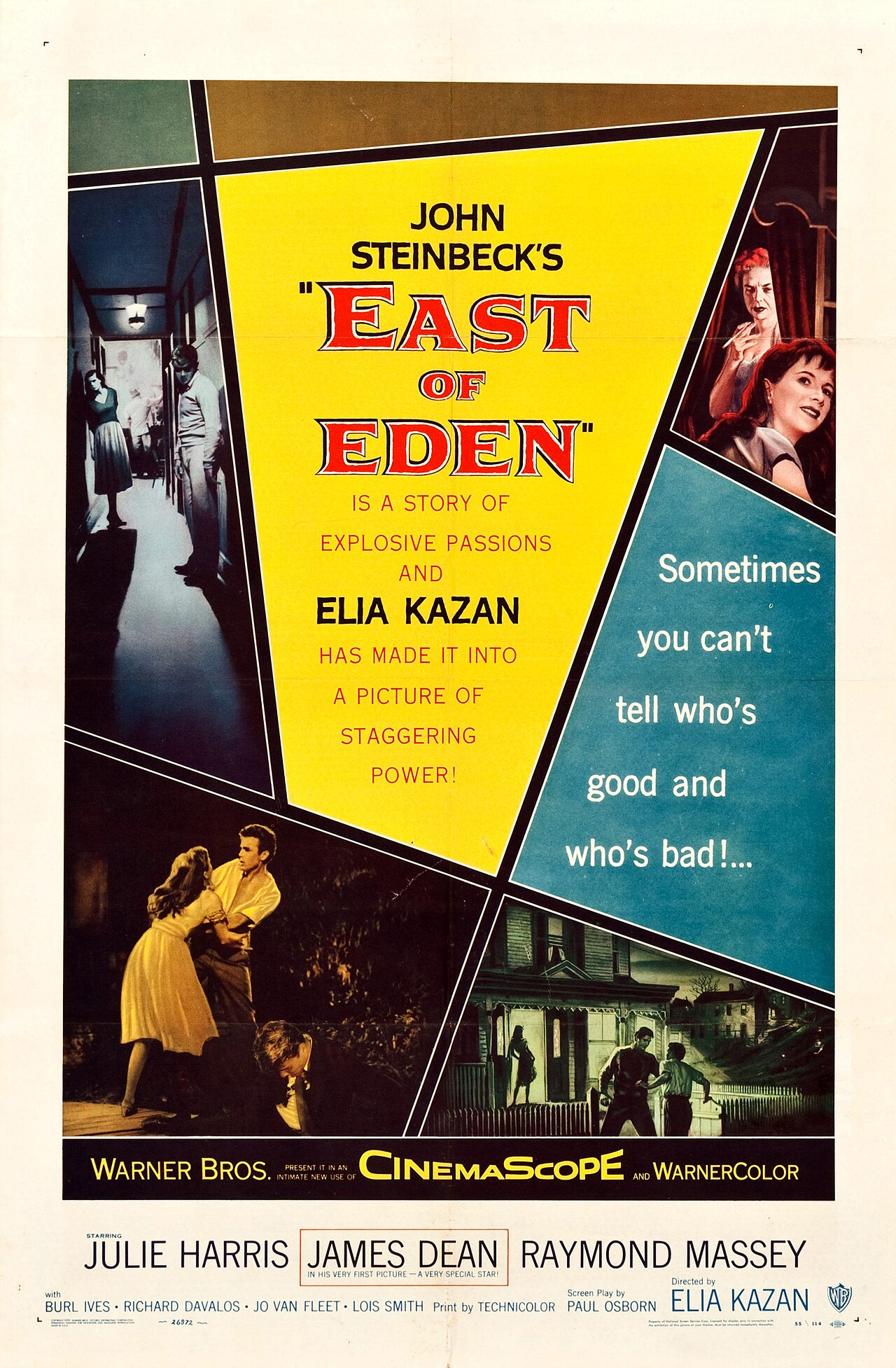
"Copyright 1955 Warner Bros. Pictures Distributing Corporation " · Public domain
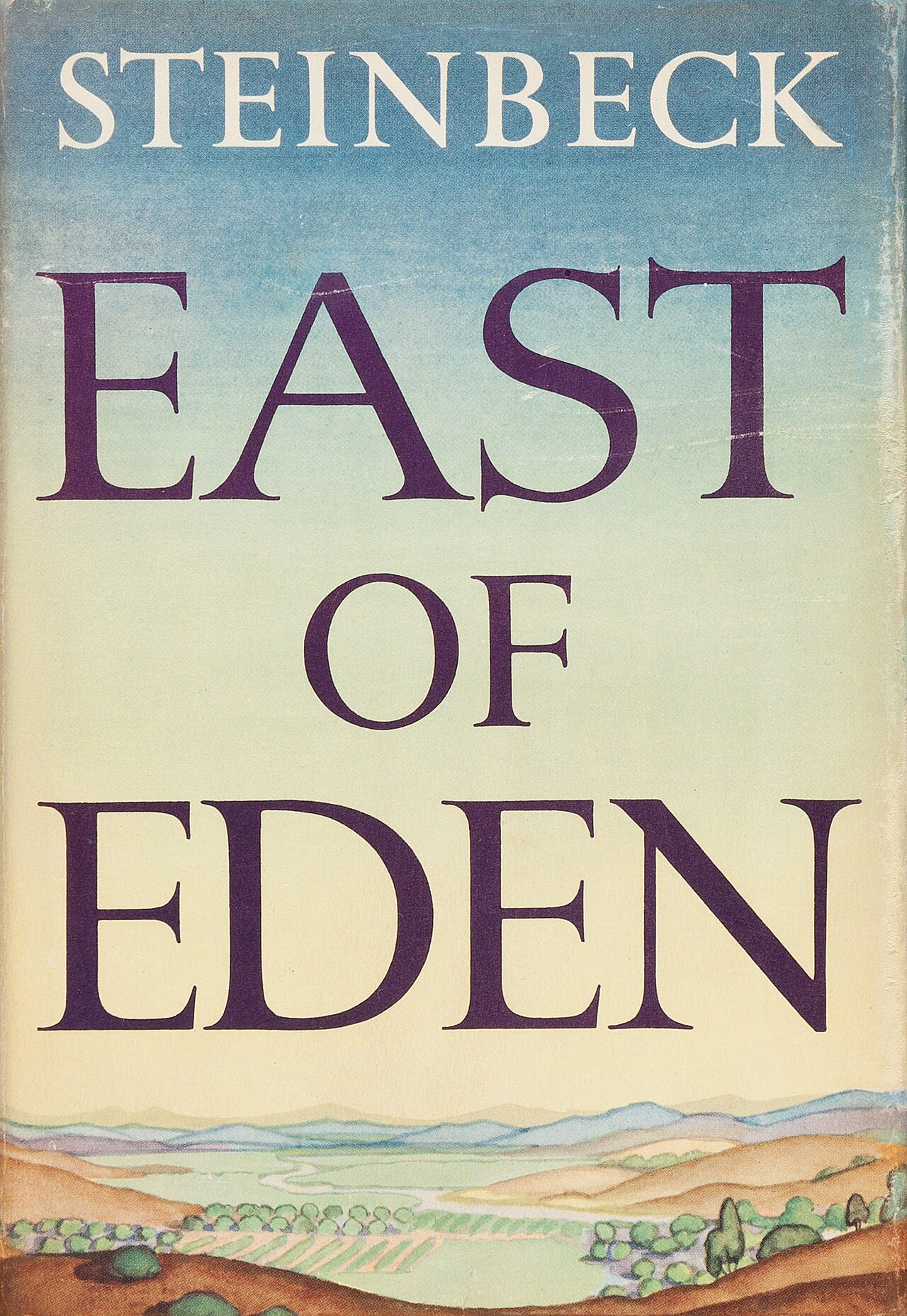
Many regard the work as Steinbeck's most ambitious novel, and Steinbeck himself considered it his magnum opus. The novel details the lives of two families, the Trasks and the Hamiltons, and their interwoven stories, set primarily in the Salinas Valley of Central California.
- Setting
- Salinas Valley, Central California
Lore & Background
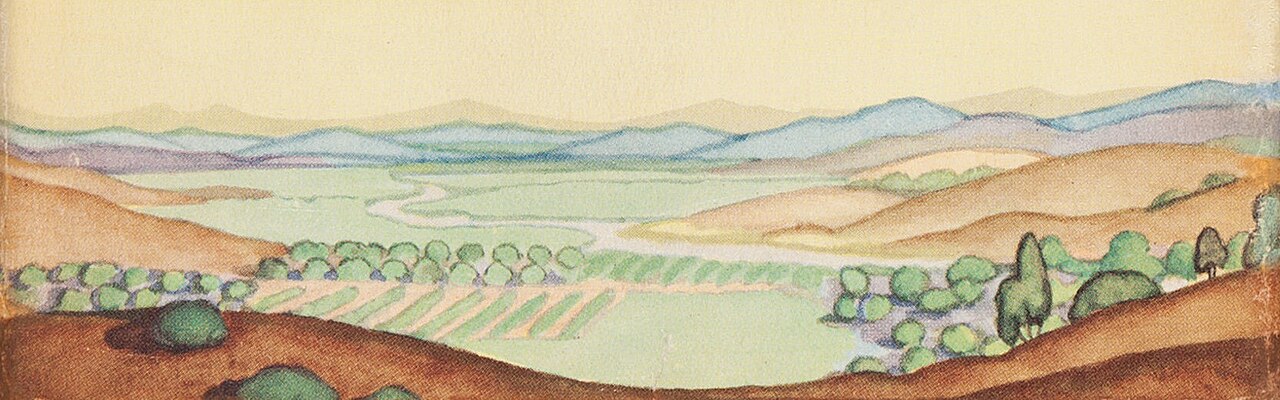
Steinbeck originally addressed the novel to his young sons, Thom and John, wanting to describe the sights, sounds, smells, and colors of the Salinas Valley for them in detail. The Hamilton family in the novel is based on the real-life family of Samuel Hamilton, Steinbeck's maternal grandfather, and a young John Steinbeck appears briefly as a minor character. The story begins with a description of the Salinas Valley and spans from before the American Civil War into the 1920s.
Reader's Guide
East of Eden is significant for its ambitious scope and its deep exploration of moral choice, symbolized by the Hebrew word 'timshel' (meaning 'thou mayest'), which Steinbeck used to convey that humans have the power to choose their paths. The novel parallels the biblical story of Cain and Abel through the brothers Caleb and Aaron Trask, and their mother Cathy Ames, who becomes a brothel madam. Steinbeck considered the book his magnum opus, stating it contained everything he had learned about his craft. The novel's themes of guilt, freedom, and the struggle between good and evil have made it a lasting work in American literature, though Steinbeck's use of 'timshel' is noted as a translation error.
Did You Know?
- Steinbeck originally addressed the novel to his young sons, Thom and John, then 6½ and 4½ years old.
- The Hamilton family is based on Steinbeck's maternal grandfather, Samuel Hamilton.
- The title comes from Genesis 4:16: 'And Cain went out from the presence of the Lord, and dwelt in the land of Nod, on the east of Eden.'
- The Hebrew word 'timshel' in the novel is actually a mistranslation; the correct word is 'timshol'.
A Father's Testament to His Sons
Steinbeck, already a Nobel laureate by the time this 1952 family saga was published, regarded East of Eden as the crowning achievement of his entire literary career. He declared that the novel contained everything he had learned about his craft over decades of writing, and he later reflected that all his previous works had been, in a sense, mere rehearsal for this one. Critics and readers widely share that assessment, frequently citing it as his most ambitious novel. What makes the book deeply personal is its dedication: Steinbeck addressed it to his two young sons, Thom and John, who were six and a half and four and a half years old at the time. His stated intention was to paint, in vivid detail, the sights, sounds, smells, and colors of the Salinas Valley for them—a sensory portrait of the landscape that shaped his own childhood. The result is a work that functions simultaneously as a sweeping American epic and an intimate letter from a father to his children, embedding the geography of his heart into the architecture of the narrative.
Timshel: The Philosophy of Choice
At the philosophical core of the novel sits a single Hebrew word that reshapes the entire moral landscape of the story. Lee, Adam Trask's Chinese-American servant and close confidant, recounts how a group of Chinese scholars in San Francisco devoted two years to studying Hebrew so they could recover the true meaning of the Cain and Abel passage, which they felt had been imperfectly rendered in English-language Bibles. Their discovery: the word timshel, meaning "thou mayest." This small correction transforms a story of divine condemnation into one of radical human agency—people are neither locked into sainthood nor condemned to sin. They possess the power to choose their own paths. The concept threads through every major relationship in the book, from Lee's long conversations with Adam and the inventive Irish immigrant Samuel Hamilton to the final scene, where a bedridden Adam, on the verge of death, looks at his surviving son Cal and simply says "timshel." In that single word, he grants Cal the freedom to break the cycle of guilt and self-destruction that has defined the family across generations, offering not a verdict but a choice.
Two Families, One Valley
The novel's architecture rests on the interwoven fates of two families—the Trasks and the Hamiltons—whose stories braid together across the Salinas Valley of Central California. The Hamiltons are drawn from Steinbeck's own family history; the character of Samuel Hamilton, the inventive and generous Irish immigrant who becomes a pillar of the community, is modeled on Steinbeck's maternal grandfather. In a small but telling touch, a young John Steinbeck also appears briefly as a minor figure within the narrative. The story's primary timeline spans from the dawn of the twentieth century through the end of the First World War, yet the first fourteen chapters reach much further back, unfolding in Connecticut and Massachusetts and stretching all the way to the American Civil War. These early sections supply the backstory for Adam Trask, his brother Charles, their father Cyrus, and Cathy Ames, establishing the family wounds and inherited tensions that will drive the California drama. Before any character is introduced, Steinbeck pauses to render the valley itself in meticulous sensory detail, grounding the human drama in a specific, living landscape.
The Brothers and the Breaking of the Cycle
The novel's emotional engine is the duality of Adam Trask's twin sons, Aron and Cal, whose very names echo the biblical Cain and Abel. Aron grows into a figure of quiet virtue and duty, destined for the Episcopal priesthood, while Cal burns with restlessness, guilt, and a fierce need to prove himself worthy of a father's love. Their lives diverge along a knife's edge: Aron's idealism is shattered when he discovers that his mother, long believed dead, is actually Kate Albey, the notorious madam of a Salinas brothel, and he recoils in horror. Cal, by contrast, confronts the same truth with a bitter, defiant clarity, telling his mother she is simply afraid. Aron enlists in the Army and is killed in the final year of the war; Adam suffers a stroke upon hearing the news. In the novel's closing moment, the dying father, urged by Lee to forgive his last remaining son, signals his pardon and utters the word "timshel," releasing Cal from the inherited weight of sin and granting him the freedom to forge his own path forward.
Gallery
Frequently Asked Questions
Who are the main families in East of Eden?
The story centers on the Trask and Hamilton families, whose rivalries and loyalties play out over several generations. Their personal conflicts mirror broader themes of good versus evil.
Where is East of Eden set?
The novel takes place primarily in the Salinas Valley of Central California, a region Steinbeck knew intimately from his own upbringing.
Why is East of Eden considered Steinbeck's magnum opus?
Steinbeck himself identified it as his most important work, and many readers and critics echo that assessment. It is widely seen as his most ambitious and personally significant novel.
What is the central theme of East of Eden?
The novel reimagines the biblical Cain and Abel narrative through a California lens, exploring the idea that humans possess the freedom to choose their moral path. Steinbeck frames this concept with the Hebrew word 'timshel,' meaning 'thou mayest.'
More in Novels & Major Fiction 1-24
Elsewhere in the Novels & Major Fiction universe
Spotted an error? Know more?
This is a living reference — every entry is fact-audited, and reader corrections feed straight into our audit queue. Suggest an edit · See this site's audit record